
DeepSeek V4 Novel Writing Capability Evaluation (Part One)
All Posts
- FeelFish Now Supports HarmonyOS PC
- FeelFish 4.0 Major Release 🐟 – Building a Professional-Grade Novel Writing Workbench
- A First Principles Approach to Web Novel Writing
- DeepSeek V4 Novel Writing Capability Review (II)
- Recruit Partners, Enjoy Cash Sharing
- DeepSeek V4 with Million-Context Capacity, Fit Your Entire Novel In!
- DeepSeek V4 Novel Writing Capability Evaluation (Part One)
- Novel Writing Enters the Multi-Agent Era — Introducing FeelFish 3.0
- FeelFish 2.13 is here with tons of new features! Come and try it out!
- FeelFish 2.13.0 Major Update: Cloud Drive + Knowledge Base + Semantic Search, Redefining the New Experience of AI Creation
- FeelFish 2.12.0 Released, Supports Generating Covers Based on Novel Content
- FeelFish Smart Planning Mode: Making AI Novel Writing More Planned
- Why Do AI-Written Novels Always Feel Repetitive? Can AI Really Write Compelling Stories?
- How to Avoid Plagiarism When Using AI to Write Novels
- FeelFish: Professional AI Novel Writing Agent Software
DeepSeek officially released the V4 version on April 24, 2026. For more details, see the official DeepSeek announcement.
It supports two model versions, Flash and Pro, both of which support 1M context. According to the official description:
-
Significantly Enhanced Agent Capabilities: Compared to previous models, the Agent capabilities of DeepSeek-V4-Pro have been significantly improved. In Agentic Coding evaluations, V4-Pro has reached the best level among current open-source models and has also performed excellently in other Agent-related assessments. Currently, DeepSeek-V4 is being used by internal employees for Agentic Coding, with user feedback indicating a better experience than Sonnet 4.5 and delivery quality close to Opus 4.6 in non-thought mode, though it still lags behind Opus 4.6 in thought mode.
-
Rich World Knowledge: In world knowledge evaluations, DeepSeek-V4-Pro significantly outperforms other open-source models, coming in just slightly behind the top closed-source model, Gemini-Pro-3.1.
-
World-Class Reasoning Performance: In evaluations of mathematics, STEM, and competitive coding, DeepSeek-V4-Pro has surpassed all publicly evaluated open-source models, achieving results on par with the world's top closed-source models.
Compared to DeepSeek-V4-Pro, DeepSeek-V4-Flash has slightly less extensive world knowledge but demonstrates comparable reasoning abilities. Due to its smaller model parameters and activations, V4-Flash can provide faster and more cost-effective API services.
In Agent evaluations, DeepSeek-V4-Flash performs comparably to DeepSeek-V4-Pro in simple tasks but shows a gap in more complex tasks.
So, how does it perform in novel writing? Let's evaluate it using FeelFish.
First, we will use the professional assistance mode with the DeepSeek-V4-Flash model, enabling the thinking mode without any additional skills, to start writing a novel titled "Opening a Restaurant in Tang Dynasty."
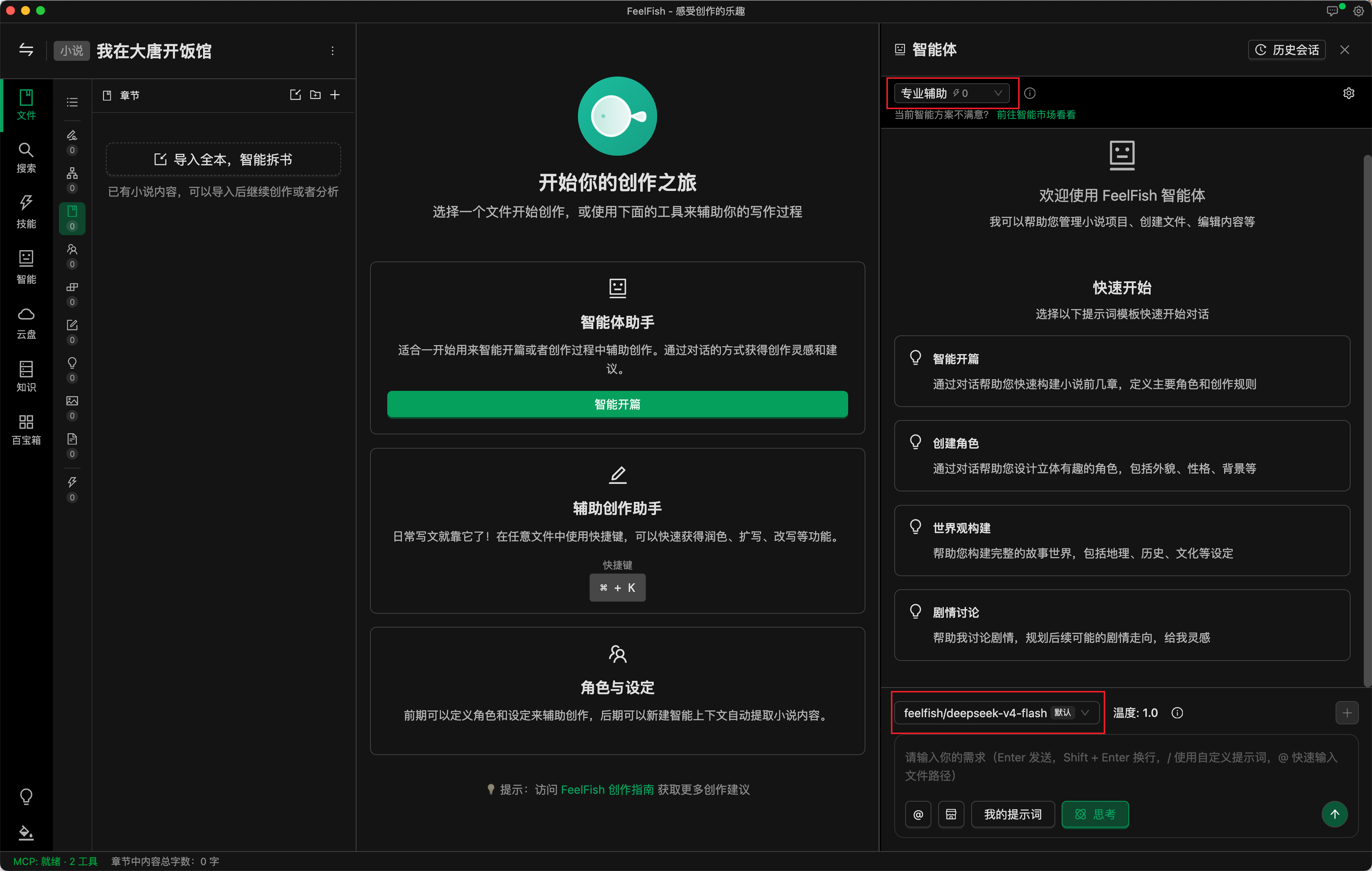
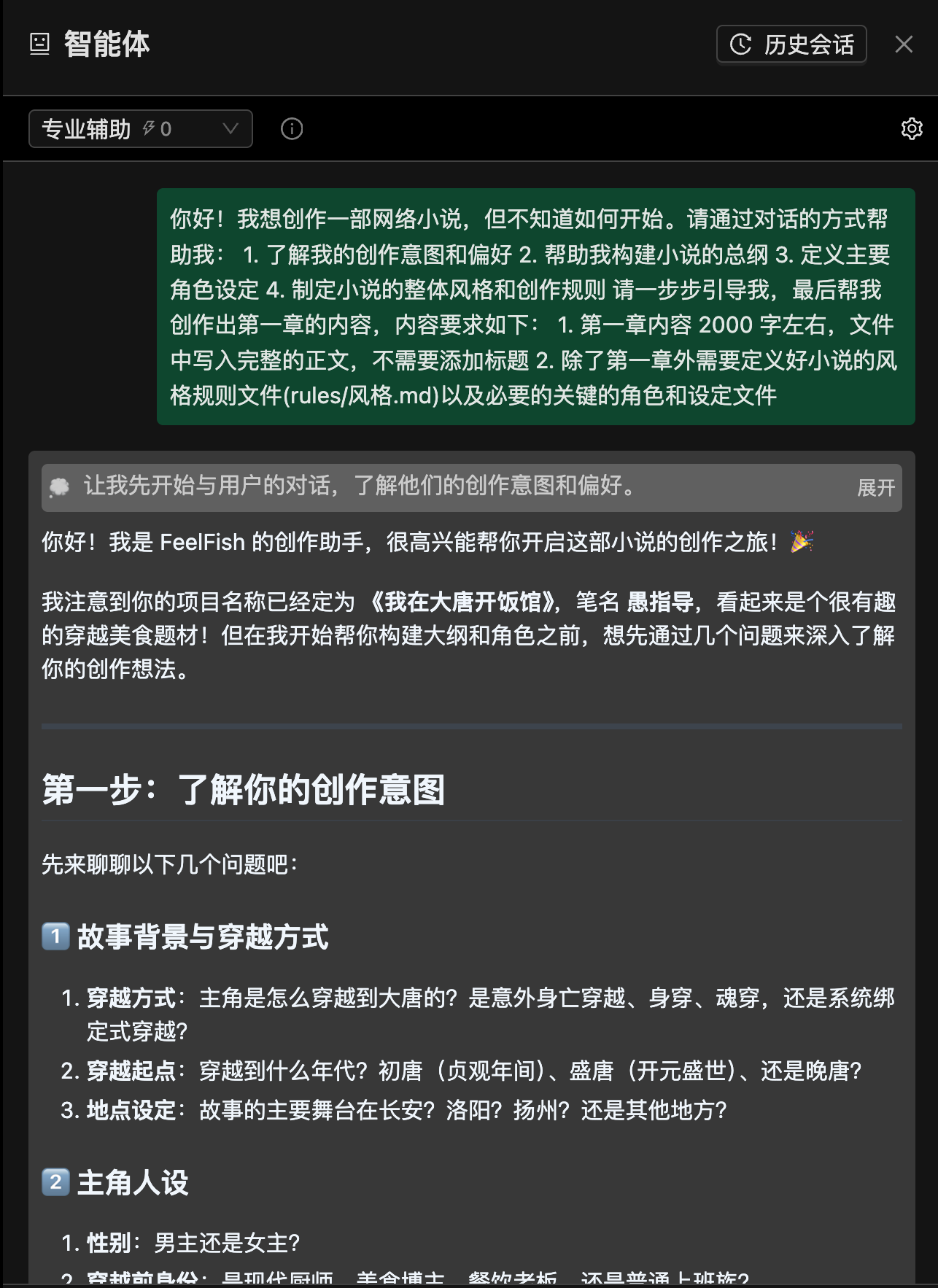
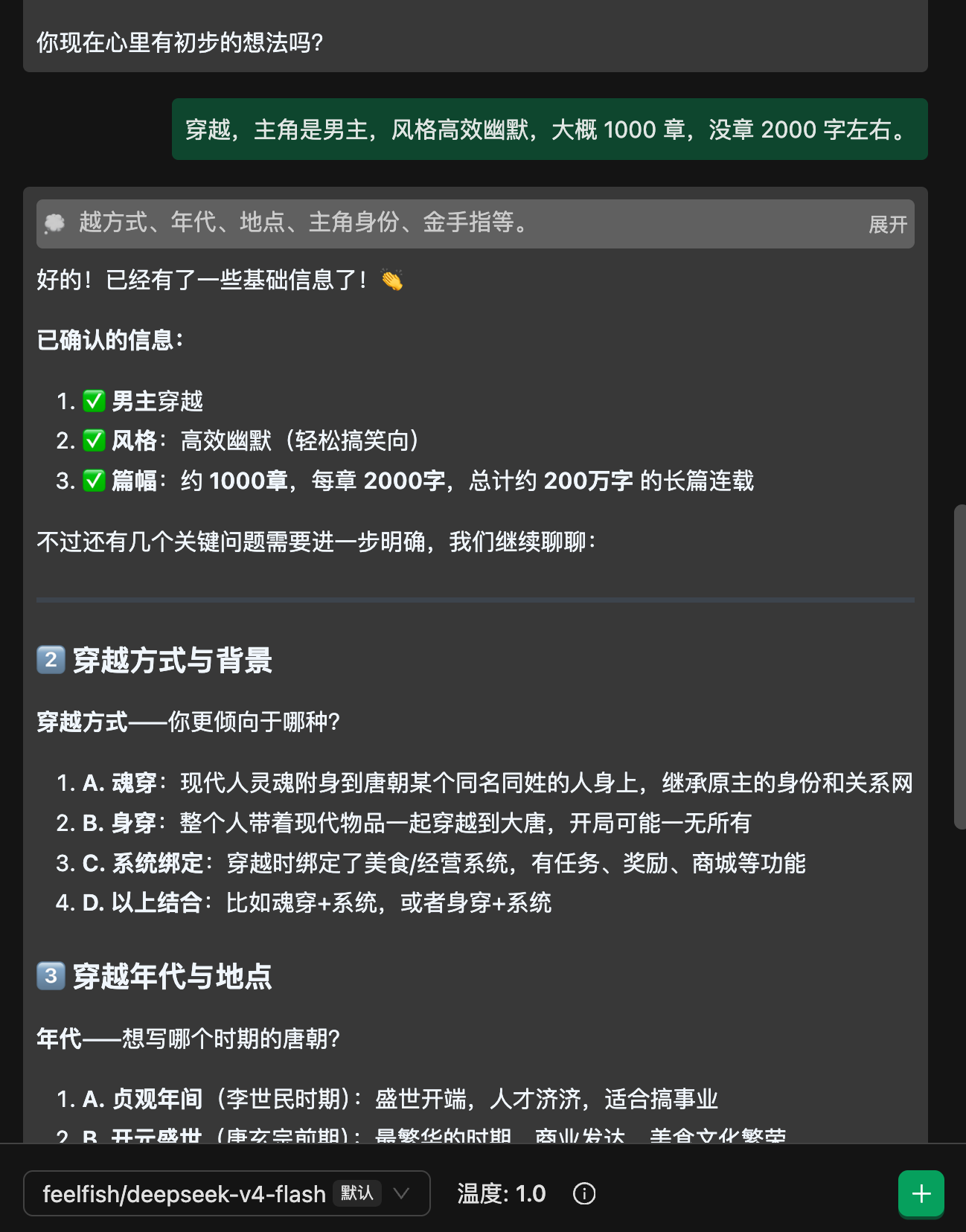
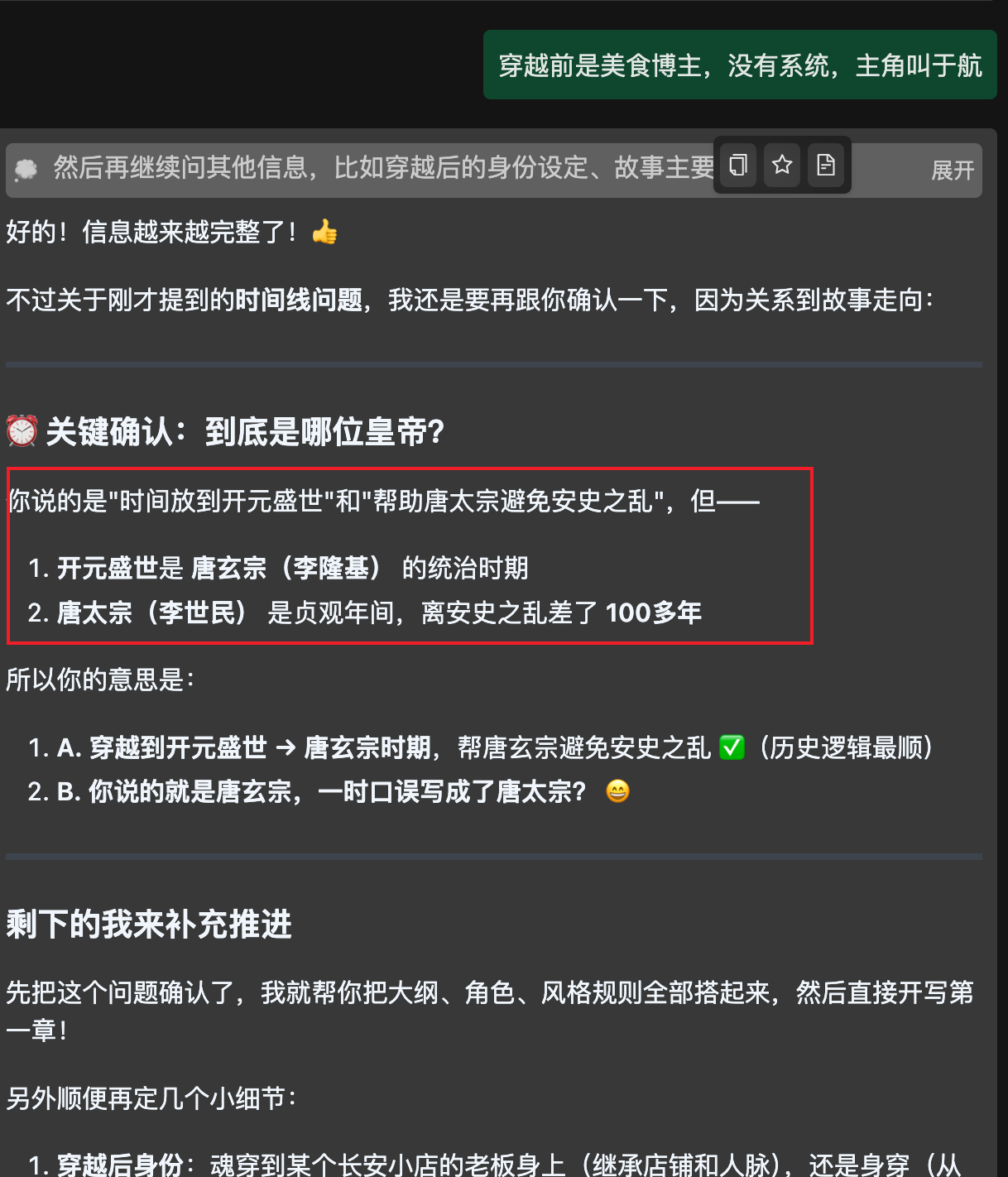
Initially, we can see that the instructions are followed quite well. After a few rounds of dialogue, compared to previous versions, it seems to be more proactive in asking the user for input rather than operating on its own.
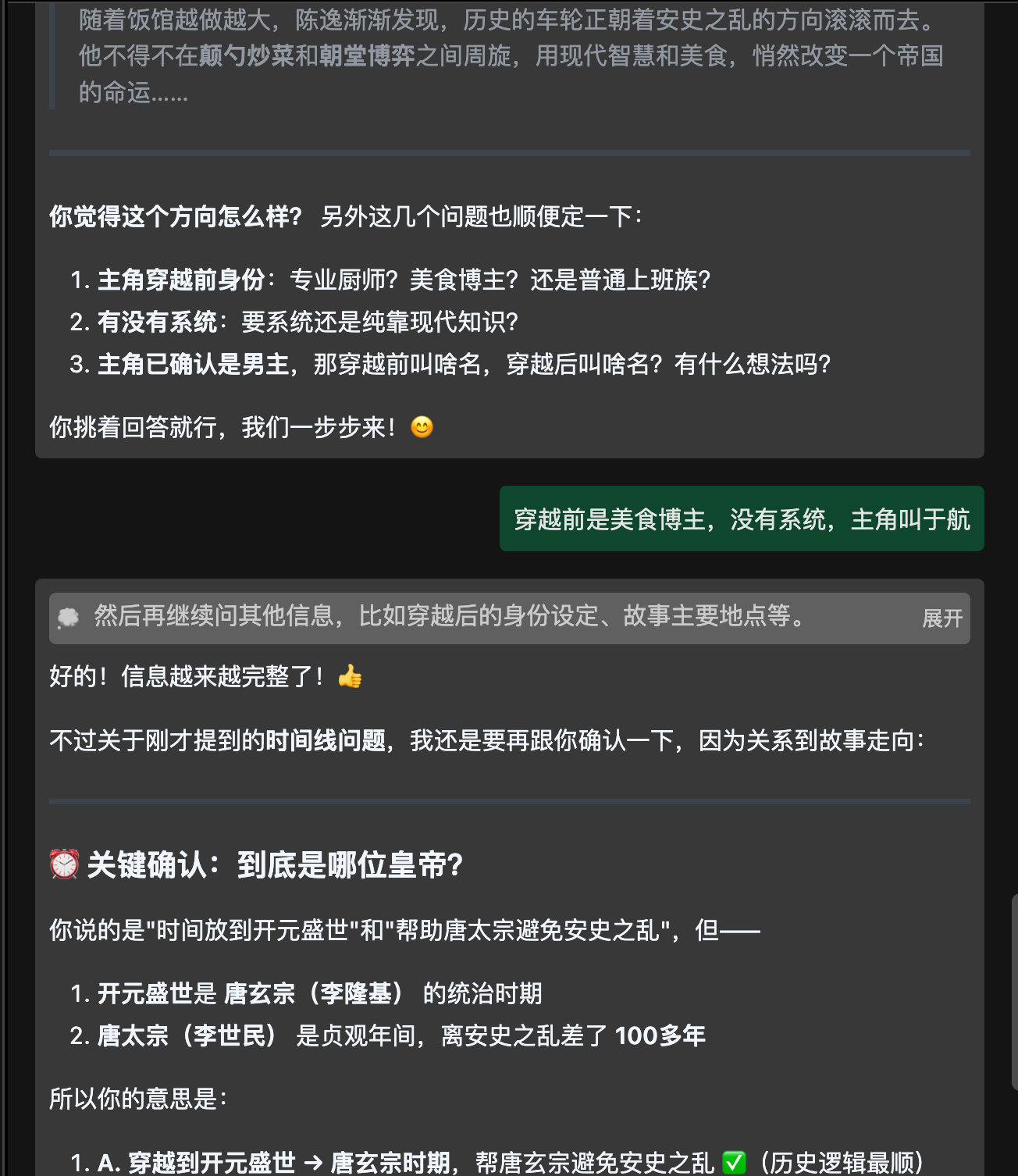
It can also accurately identify errors:
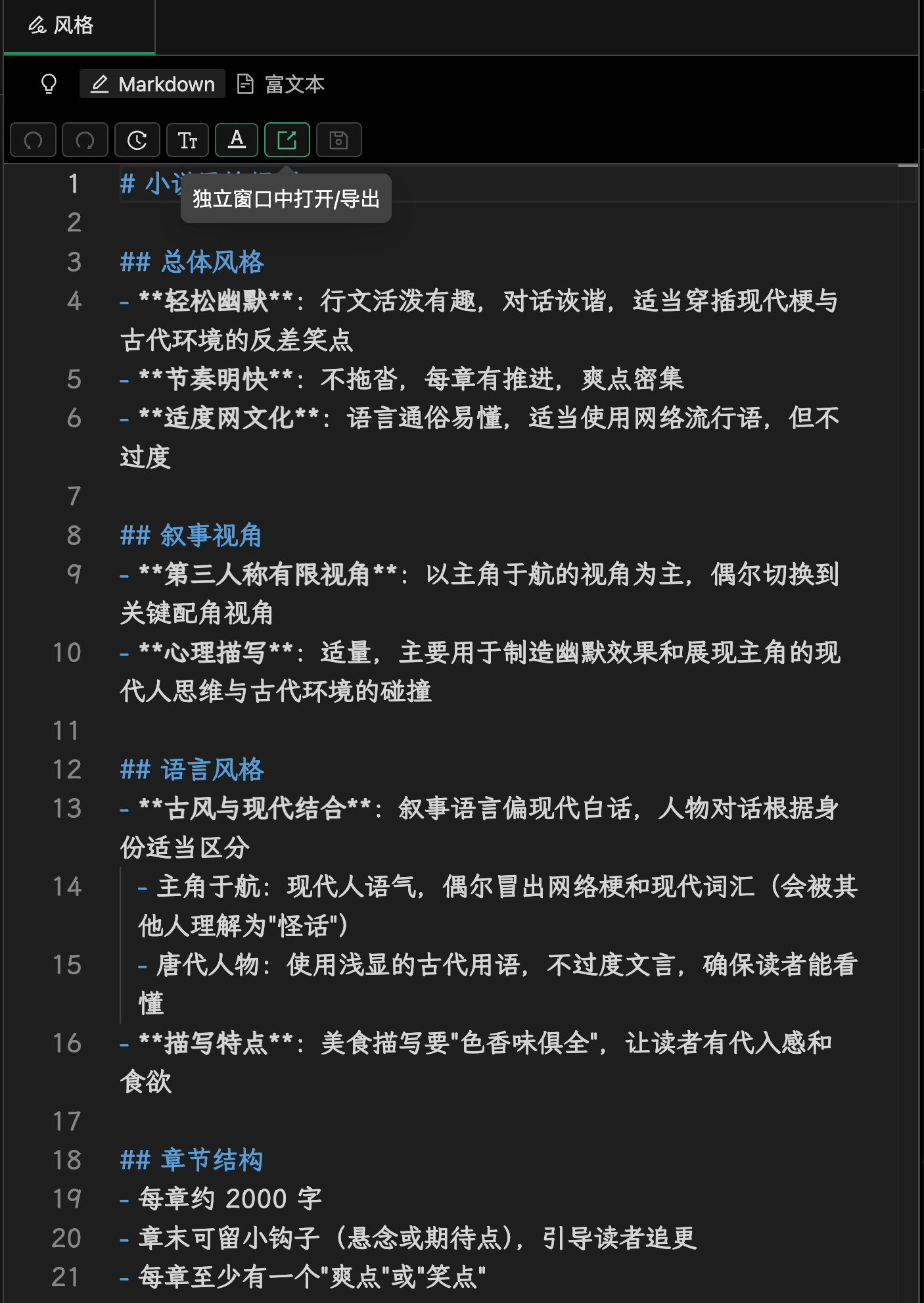
The initial style generated is quite good, and the content mentioned in the dialogue is included:
Finally, the first chapter is completed, with a word count of 2800 words, which is an improvement over V3.2! V3.2 typically produces chapters of 3000 to 4000 words. Let's take a look at the content:
Yu Hang's last memory was in an abandoned ancient temple deep in the Qinling Mountains.
He was holding his phone, passionately explaining to the camera, with an old, moss-covered well behind him. The live chat was filled with messages like "Little Chef Yu, be careful" and "This place looks so eerie." Just as he was about to say, "The more such places, the better the ingredients," he slipped and fell backward.
And then, there was nothing.
When he woke up again, Yu Hang found himself lying in a dense forest, with sunlight filtering through the leaves and birds chirping around him. The air was incredibly fresh.
"Did my fans save me?"
He sat up and dusted off the dirt from his clothes. His phone was still in his hand, but the screen was shattered and unresponsive. His backpack was still there, containing a few packs of instant noodles, a thermos, a multi-tool knife, and half a pack of compressed biscuits.
"Well, this will make for some exciting video footage."
Yu Hang stood up, brushed the mud off his pants, and started walking down the mountain. After about half an hour, he saw the first living person—a farmer in coarse clothing, leading an ox along the ridge.
"Sir!" Yu Hang greeted him warmly, "Could you tell me how to get to the nearest village?"
The old farmer looked up, his eyes filled with shock and confusion. It was no wonder; a young man in a white T-shirt and jeans, covered in dirt, appearing on the field path would leave anyone bewildered.
"Who... who are you?" The old farmer took two steps back, sizing Yu Hang up and down.
Yu Hang was taken aback. The old man was speaking Mandarin, but with an odd accent, like something from an ancient drama on TV. The good news was that he could understand it.
"I'm... a traveler who got lost," Yu Hang smiled. "Sir, is there a town nearby?"
"Follow this road east for twenty li, and you'll reach Chang'an."
Chang... An?
Yu Hang's brain froze for three seconds.
"Sir, may I ask, which dynasty is this?"
"Dynasty?" The old farmer looked at him as if he were an idiot. "It's the nineteenth year of the Kaiyuan era. How could you not know this?"
The nineteenth year of the Kaiyuan era. Emperor Xuanzong. Yang Guifei. Li Bai. And—An Lushan Rebellion.
Yu Hang felt like his whole world had turned upside down.
He spent an entire day digesting this fact: he had time-traveled. Not for a show, not a dream, but truly from 2025 to the prosperous Kaiyuan era of 731 AD in the Tang Dynasty.
The good news was: he had traveled to the most prosperous period of the Tang Dynasty, to the capital city of Chang'an, where opportunities were abundant.
The bad news was: all he had was a broken-screen phone, half a pack of compressed biscuits, a packet of instant noodles, a thermos, and a small knife. Things that were worthless in the modern world were even less valuable here, not even enough to buy a steamed bun.
"Alright, since I'm here, I might as well make the best of it." Standing before the grand gates of Chang'an, Yu Hang took a deep breath. "In the江湖,哪能不挨刀。挨了刀也要笑着继续飘。"
Chang'an was even more magnificent than he had imagined. The towering city walls stretched endlessly, and a long queue formed at the gate, with camel-riding merchants, peddlers carrying baskets, and rich young men on tall horses, creating a bustling scene.
There was no entrance fee, but one needed to show a travel permit (identity document). As Yu Hang was worrying about how to get in, a merchant caravan ahead started arguing with the guards, drawing their attention. He seized the opportunity and slipped into the city, head down.
Once inside, the strong atmosphere of the marketplace hit him. Shops lined both sides of the street, selling cloth, jewelry, and flatbreads, with vendors shouting their wares. The ground was made of compacted earth, trodden firm by countless feet. Passersby wore a variety of clothing, from silk robes of wealthy merchants to coarse cotton shirts of commoners, and even turbans of foreign traders.
Yu Hang felt like he had stepped onto the set of *The Longest Day in Chang'an*.
But he had no time to admire the sights. His stomach growled, reminding him of a very real problem—he was hungry.
After rummaging through his pockets, he found only a set of modern keys and a few hundred-yuan bills. He squatted by the roadside, watching the passing crowd, his mind racing.
What could a food blogger do in ancient times?
The answer was obvious.
He observed the street food stalls. Flatbreads, steamed buns, and porridge were the main offerings, with cooking methods limited to roasting, steaming, and boiling. The aromas were simple, mostly just salt and soy sauce.
"Stir-frying hasn't become popular yet..." Yu Hang licked his lips.
Iron pot smelting technology in the Tang Dynasty was not advanced enough, and while stir-frying had appeared, it was far from widespread. Most people still used clay pots or bronze cauldrons for cooking.
And he, a modern food blogger proficient in Sichuan, Shandong, Cantonese, and Huaiyang cuisines, had a complete system of stir-frying techniques and seasoning concepts in his head. If he could put them to use, it would be a culinary revolution for the Tang Dynasty.
The problem was, he didn't even have a pot.
After wandering the streets for a while, Yu Hang finally found a discarded, rusty iron pot at a scrap collector's. The pot had a small hole in the bottom and was covered in rust. He used some stones to hammer it, then patched the hole with mud and broken tiles.
He asked the old man for a few bamboo skewers, a small jar of salt, and a small jar of oil. The old man, seeing his plight, agreed to give him these in exchange for helping him unload a cart of firewood. Without a word, Yu Hang helped the old man, working until his back ached, but he finally got what he needed.
"The beginning is always the hardest." Yu Hang encouraged himself.
He found a corner near the Western Market, built a makeshift stove with stones, and gathered some dry wood to start a fire. He placed the patched pot on the stove and poured in a little oil—oil was precious, and plant oils were not as cheap in the Tang Dynasty as they were in modern times.
It was midday, and the street was bustling with people. A little girl in tattered clothes, her face dirty, walked past him, clutching a copper coin. She hesitated in front of a flatbread stall but eventually couldn't bring herself to buy anything.
Yu Hang felt a pang of sympathy. He remembered the feeling of craving street food as a child but not being able to afford it.
"Little girl, come here," he called out, waving to her.
The little girl looked at him warily and took a step back.
"Don't be afraid, I'm not a bad person," Yu Hang smiled. "I'll give you something to eat, for free."
He took out the packet of instant noodles from his backpack—the only thing he had that could be considered "food." He tore open the package, broke the noodle cake into pieces, and poured out the seasoning powder, which contained salt, MSG, and spices, a veritable elixir for Tang Dynasty palates.
The pot heated up, and he added the oil, filling the air with a fragrant aroma. He quickly stirred the broken noodles, and the starches caramelized, releasing a rich, wheaty scent. He sprinkled in the seasoning powder, and the air was filled with a mouth-watering fragrance.
Passersby stopped to look, curious.
"What is that smell?" "It smells so good..." "I've never smelled anything like this before!"
Yu Hang picked up a small clump of the stir-fried noodles with a bamboo skewer and offered it to the little girl. She hesitated for a moment, then took it and put it in her mouth—
Her eyes widened instantly.
It was a flavor she had never experienced. The intense savory taste exploded on her tongue, and the complex aroma of the spices rushed to her head. The fried noodles were crispy on the outside and soft on the inside, each bite a new and delightful experience.
"S-S-So delicious!" The little girl's voice trembled with excitement.
The onlookers around him began to stir with excitement. A middle-aged man in a long robe approached and asked, "Young man, what are you selling? And how much is it?"
Yu Hang grinned, continuing to stir-fry the noodles in the pot.
"Special homemade stir-fried noodles, three coins per serving."
Three coins, the price of a flatbread, was not expensive.
"I'll have one!" "Me too!" "I was here first!"
In no time, a long line formed in front of Yu Hang's battered pot. He only had three packs of instant noodles in his backpack; he had given one to the little girl as a treat, and the remaining two were quickly sold out.
In the end, he made ten servings of stir-fried noodles, each for three coins—totaling thirty coins.
Yu Hang clutched the small string of copper coins, his hands trembling. Not from excitement, but because—this was such a meager amount. Thirty coins in Chang'an City would only be enough for a few simple meals, and not even enough to rent a decent place to stay.
But, this was the first money he had earned since arriving in the Tang Dynasty.
Thirty coins.
Yu Hang counted the copper coins one by one, tucking them into his pocket, and a bright smile spread across his face.
"Alright, a good start."
He looked up at the grayish-blue sky of Chang'an, taking a deep breath. In the distance, an endless sea of rooftops stretched out, with banners on the taverns flapping in the wind, and the sound of camel bells from foreign traders echoing from around the corner. The entire city was like a massive, boiling furnace.
Yu Hang, a food blogger from 1,300 years in the future, was determined to make a splash in this world.
"Boss, are you coming back tomorrow?" a diner called out as he caught up.
Yu Hang turned, grinning:
"Of course. I'll bring something even more impressive tomorrow."
He had already made up his mind—tomorrow, he would make a real egg-fried rice. That would be his first step in conquering the taste buds of Chang'an.
The overall logic is smooth, and the key prop, "a few packs of instant noodles," is well-referenced throughout the first chapter. However, the ending still has the same old issue of becoming overly sentimental, indicating that skill tuning is still needed.
I also tried changing the protagonist's name to "Shen Yi," and the tool worked without any issues, updating all the relevant files:
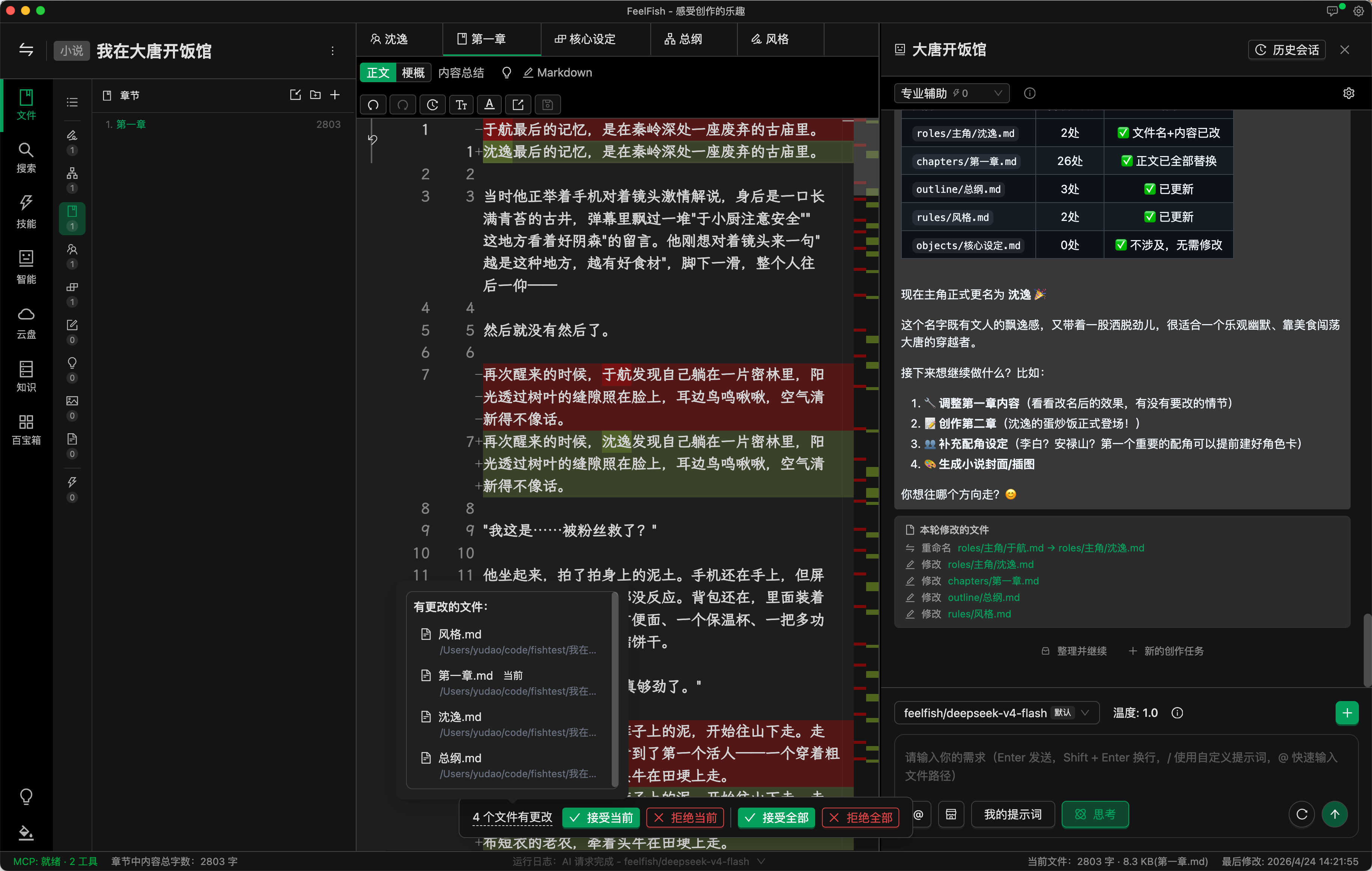
From the initial look, DeepSeek V4-Flash is no worse than DeepSeek V3.2. Tool invocation, communication, and logical capabilities seem to be on par. Given that it's nearly half the price of DeepSeek V3.2, it's definitely worth it!
We will continue to evaluate the performance of DeepSeek V4 Flash and Pro in terms of skill invocation and maintaining long-form plot consistency. Stay tuned for our upcoming articles.