
Fanqie Novel Removes Nearly 9,500 Posts and Bans 271 Accounts in September: Tightening on Both Copyright and Quality Ends
Fanqie Novel Removes Nearly 9,500 Posts and Bans 271 Accounts in September: Tightening on Both Copyright and Quality Ends
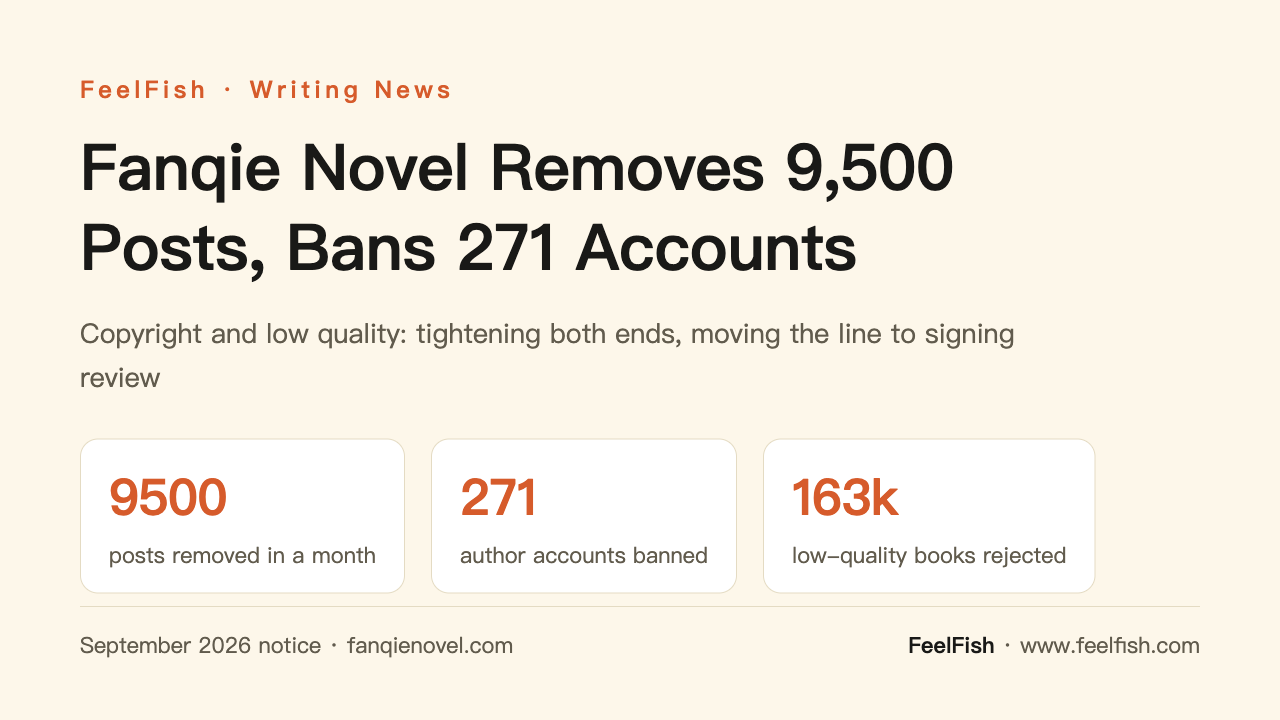
On October 9th, Fanqie Novel posted the "September 2026 Fanqie Platform Account Violation Penalties" in the author section. The announcement was brief and straightforward with the numbers: 4,861 web novels and 204 accounts were taken down and banned for copyright violations; 4,638 short stories and 67 accounts were also removed and banned for the same reason. Additionally, a batch of web novel and short story author accounts were banned for security violations, all disclosed at the same time. In total, nearly 9,500 works disappeared from Fanqie in September due to copyright issues, and 271 author accounts were banned.
1. What Two Types of Issues Were Addressed in the September Announcement
The announcement categorized the violations into two main areas. The first is copyright violations, which resulted in the "removal of works + account bans"; this affected both web novels and short stories in September. The second is security violations, which led to the banning of author accounts. The platform made it clear that penalties would vary based on the severity and frequency of the violations, up to permanent bans.
What stands out this time is the scale. Copyright violations are no longer isolated incidents but have reached a scale of nearly 10,000 works per month. As AI has drastically reduced the cost of patching, rewriting, and using templates, the platform must also reduce its cleanup costs—hence, the shift from "individual takedowns" to bulk removals and bulk bans.
2. Looking at the August Report Together Provides Clearer Direction
Going back one month, on September 9th, Fanqie released the "Fanqie Novel Low-Quality Governance Announcement (August)," which provided the following figures: since August, 163,000 low-quality books were rejected, and 61,000 low-quality and rule-violating books were dealt with. The rules were clearly stated—issues included AI-generated poor quality, formatting chaos, structural abnormalities, and empty, watered-down content.
The typical cases in the announcement were divided into three categories: mechanically written, hollow prose; severe AI-generated poor quality; and overly ornate, rigidly structured, and poorly written text. The former were taken down, while a significant portion of the latter two categories were blocked during the contract review stage, meaning they never even had the chance to be published and earn royalties.
When looking at both announcements together, it's clear that the platform is tightening its grip on two fronts: "plagiarism" and "low quality." Moreover, the point of intervention has shifted from post-report takedowns to the contract review stage.
3. The Platform Has Also Clarified What It Encourages
In the latter part of the low-quality governance announcement, Fanqie listed five content standards it encourages, each worth reading in detail:
- Engaging Story Content: The core setting should be compelling at first glance; the story should quickly dive into the main plot; the protagonist and key supporting characters should have clear motivations and drive the plot forward from their first appearance; the story should be complete and not leave loose ends.
- Unique and Innovative Ideas: Any novelty in the world-building, character design, special abilities, plot, or narrative style is worth encouraging.
- Deep and Meaningful Themes: The work should go beyond simple moral judgments and delve deeply into real-life experiences and value choices through the characters' journeys and central conflicts.
- Smooth and Fluent Writing: The writing should be coherent and fluid with few grammatical errors; descriptions should be vivid and avoid long-winded, empty dialogue.
- Good Potential for Development: The structure should be complete, the main plot clear, and the pacing steady, maintaining quality throughout a long-form serialization.
These five points actually form a reverse checklist. Each item addresses common issues in AI-generated content: meandering beginnings, unclear character designs, disjointed plots, beautiful sentences that lack substance, and a drop in quality midway through a series.

4. What This Means for Writers
From the launch of the completed work contract model by Fanqie Novel on September 8th, which raised the bar for signing contracts, to the low-quality content governance in August, and the mass penalties in September, these documents all point to the same trend: the platform is not short of manuscripts but is in need of stories that can attract readers and be adapted into IPs. As the scarcity shifts, so do the rules.
When it comes to the actual writing process, the key distinction is not whether AI is used, but where in the process it is applied:
- Using AI to expand 10,000 words into 30,000, applying templates in bulk, and stitching together content from various sources—these three actions are explicitly prohibited by the announcements, leading to content removal, account bans, and rejection of contracts.
- Using AI to check for consistency in worldbuilding, monitor character arcs and timelines, and suggest multiple directions for a stuck chapter—these actions do not produce "fluff" and instead address the specific weaknesses that the platform aims to improve.
This is especially true for long-form works. The announcements encourage story completeness, clear main plots, stable pacing, and consistent quality, which are precisely the areas where long-form writing often falters. Using tools to ensure these aspects remain solid is more in line with the current platform guidelines than using them to speed up the writing process.
Information Sources
- Fanqie Novel Platform Account Violation Penalties Announcement (September 2026) (2026-10-09)
- Fanqie Novel Low-Quality Content Governance Announcement (August) (2026-09-09)
- Fanqie Novel Completion Contract Model Launch Notice (2026-09-08)
About FeelFish
If you've read this far, you're likely either writing a novel or preparing to start one. You might want to try out our tool, FeelFish:
- Consistent Long-Form Writing: Automatically incorporates the entire book's worldbuilding, character relationships, and previous plot points into the context, so you don't have to manually paste background information every time.
- Multi-Agent Collaboration: Different agents handle planning, writing, and reviewing. When you get stuck, they provide several directions to choose from, and someone will watch out for issues like inconsistent character development.
- Model Flexibility: Supports integration with commonly used models, and you can also use your own API Key.
Want to give it a try? Download FeelFish for Free