
Amazon KDP Caps New Titles at 2 per Week: AI Mass Publishing Is Being Throttled
Amazon KDP Caps New Titles at 2 per Week: AI Mass Publishing Is Being Throttled
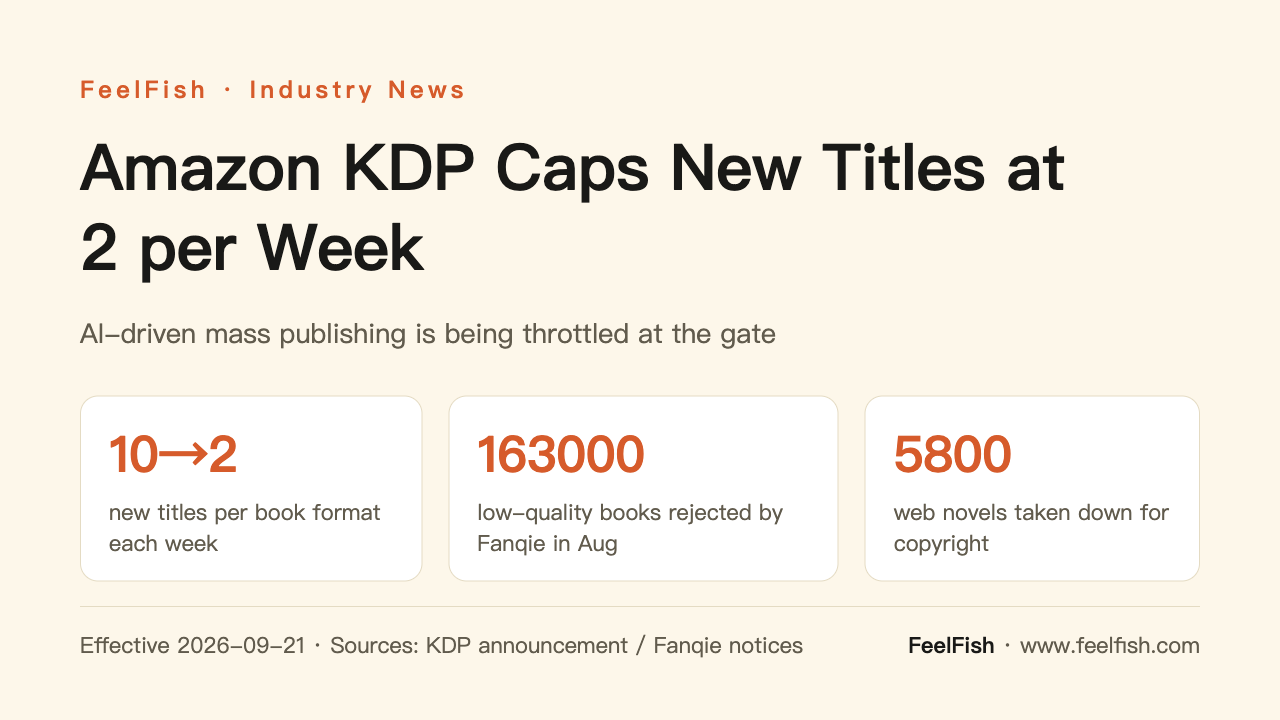
Starting September 21, Amazon's self-publishing platform, KDP (Kindle Direct Publishing), reduced the limit on the number of new books that can be created in a week from 10 to 2 per format. This change is particularly significant for authors who are accustomed to releasing entire series at once and for teams that rely on bulk publishing low-content books (such as journals and workbooks) and multiple language versions.
1. The Official Announcement is Brief but Sets Clear Boundaries
The notice posted by KDP in their official community is short, stating: "We are updating the title creation limits on KDP to help maintain a positive publishing experience for all authors. Starting Monday, September 21, 2026, you can create up to 2 titles per format per week."
The accompanying FAQ clarifies several key points:
- Limits are per format, not per account total: 2 titles each for eBooks (Kindle), paperbacks, and hardcovers, totaling up to 6 new titles per week across all formats;
- Weekly reset occurs at 00:00 UTC on Sundays, with the official statement being "Your weekly limit resets every Sunday at 12:00 AM UTC," and unused quotas do not carry over;
- Only new title creation is restricted: Existing books, revisions, cover changes, and price adjustments are not affected;
- No distinction between languages and markets: In KDP, each language version is considered a separate title, so the Chinese, English, and Japanese versions of the same work will each count toward the limit.
There's another subtle signal that's easy to miss: The KDP help page previously included a line after the limit, stating, "If you expect to frequently create a large number of titles, please contact us to request an exception" — this sentence has been removed from the new help page. We verified the English version of the "Create a Book" help page on September 26, and the section now only states: "we limit the number of titles you can create at the same time to 2 per book format each week." This means that this time, it's not just a reduction in the limit with a backdoor; they have completely closed the loophole.
2. This Isn't the First Time; the 2023 Announcement Specifically Mentioned Generative AI
KDP's production limits have been around for a while. In September 2023, the platform introduced its first restrictions (at the time, it was 3 books per day), and the announcement was quite straightforward: "we are actively monitoring the rapid evolution of generative AI and the impact it is having on reading, writing, and publishing," followed by, "in order to help protect against abuse, we are lowering the volume limits we have in place on new title creations." This means that these limits were implemented from the start to address "abuse."
In the same month, KDP also introduced AI content disclosure: any text, images, or translations generated by AI must be indicated when publishing or republishing a book. The limit was adjusted once in 2025 (to "10 titles per book format per week"), and now it has been reduced directly from 10 to 2.
It's worth noting the change in tone: the 2026 announcement made no mention of AI, simply stating that the move was "to help maintain a positive publishing experience for all authors." Industry media interpreted this as a response to the influx of AI-generated content. The Alliance of Independent Authors (ALLi) compared this to Kobo's earlier public stance, where Kobo stated it had rejected about 45% of submitted titles and explicitly chose to prioritize "authors over readers" in its approach to AI. While this is industry interpretation and not an official statement from Amazon, the direction is clear: platforms are shifting from "cleaning up after the fact" to "limiting the flow at the entry point."
3. Meanwhile in China: Fanqie Novel Rejected 163,000 Low-Quality Books in August
Turning our attention back to China, the timeline is almost synchronized. Fanqie Novel's "Low-Quality Governance Announcement (August)" provided some figures: in August, based on rules such as "AI-generated, poorly formatted, structurally flawed, and empty content," 163,000 low-quality books were rejected, and 61,000 low-quality and rule-violating books were dealt with. The same month's account violation penalties showed that 5,800 web novels were taken down and 90 accounts were banned due to copyright violations, while 4,084 short stories were removed and 61 accounts were banned.
While overseas platforms are limiting the inflow, domestic platforms are cleaning up at both the signing and publishing stages. The methods differ, but the goal is the same: content produced in large quantities is being systematically squeezed out of distribution channels.
4. How Serious Writers Can Respond
- Plan Ahead: Series, box sets, and reissues should be scheduled in weekly batches, with pre-orders becoming a standard practice rather than an optional one.
- Re-evaluate Multilingual Release Schedules: A work published in five languages could previously be released all at once, but now, with a limit of two new titles per week, it would take at least three weeks.
- Don't Treat Quotas as Goals: Two books per format is a cap, not a target. Filling the quota with low-quality content is exactly what the platforms want to eliminate.
- Use AI for Quality Improvement: Fanqie Novel's list of issues did not include "using AI." Instead, it focused on "mechanical writing, excessive wordiness, rigid sentence structures, structural flaws, and lengthy, ineffective descriptions." These are areas where tools can help—consistency checks, worldbuilding and timeline management, and terminology uniformity across languages—rather than expanding one chapter into three.
The Window is Narrowing, but It's Also Becoming Clearer
Over the past two years, AI has lowered the barrier to "publishing a book" to almost zero, but at the cost of readers and platforms having to sift through a lot of noise to find quality content. Now, with KDP limiting uploads to 2 per format per week, the strategy of flooding the market with quantity is coming to an end. The remaining space will belong to those who can write a book from the first page to the last.
For those using writing tools, this change is actually good news: competition is being refocused on the content itself—whoever can tell a complete story, develop well-rounded characters, and produce readable multilingual versions will have the best chance in the next round. The value of these tools is shifting from "helping you write faster" to "helping you write more consistently."

Information Sources
- KDP Official Announcement: Update on KDP Title Creation Limits (Effective from September 21, 2026)
- KDP Help Page: Create a Book - Title creation limit (Checked on September 26, 2026)
- KDP's First Limitation Announcement in 2023: Update on KDP Title Creation Limits
- The Guardian: Amazon restricts authors from self-publishing more than three books a day after AI concerns
- ALLi: News Summary: Amazon Cuts KDP Weekly Upload Limit to Two Titles Per Format
- Publishers Lunch: KDP Limits Authors To Two New Titles A Week
- Fanqie Novel Low-Quality Content Governance Announcement (August)
- Fanqie Novel Platform Account Violation Penalties (August 2026)