
Qidian Provides Minimum Guarantee for Low-Subscription Quality Books: Initial 1 Billion Qidian Coins, Comic Adaptations Advanced to Ongoing Serials
Qidian Provides Minimum Guarantee for Low-Subscription Quality Books: Initial 1 Billion Qidian Coins, Comic Adaptations Advanced to Ongoing Serials
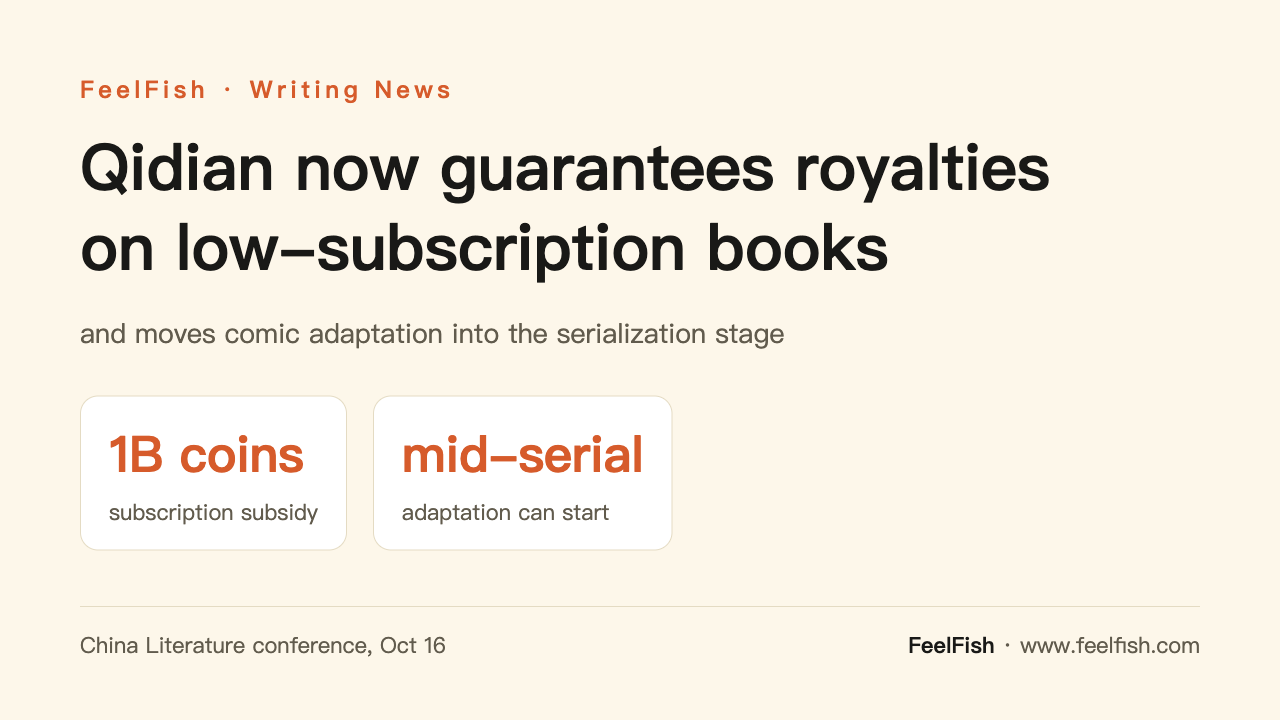
At the Reading and Writing Conference on October 16, Chief Editor Yang Chen announced two initiatives that directly benefit authors. The first is about money: Reading and Writing will continue to distribute free coins and discount coupons to Qidian users, with an initial 1 billion Qidian coins specifically for subscribing to "high-quality, low-income content." The platform will cover the costs, while authors will receive their full royalties. The second initiative is about adaptations: the support for Qidian Manhua (comic adaptations) will expand from top-tier works to mid-tier and potential works, and the adaptation process will start during the serialization phase rather than waiting until the work is completed. On October 29, the comic creation tool DramaBuddy was officially integrated into Tencent's WorkBuddy. Meanwhile, CEO Hou Xiaonan made a clear distinction: "AI can be used for literary adaptations, but the literature itself should not be created by AI."
1. This Safety Net Is Not a Subsidy
Let's clarify the nature of this initiative: the 1 billion Qidian coins are not a bonus for authors; they are used by the platform to pay for subscriptions. The process involves the platform distributing free coins and discount coupons to users, who then use them to subscribe to high-quality works with lower subscription numbers. Authors receive their full royalties, and the platform covers the difference.
So, it achieves two things: it sets a minimum income for authors and provides a space where good content can be read even if it doesn't follow market trends. According to Yang Chen, the goal is to encourage authors to fully express themselves, ensuring that even if they don't chase market trends, as long as the content is good, they will have both traffic and income guarantees.
However, don't consider this as part of your income planning. The target is "high-quality, low-income content," and the platform has the final say in determining which works qualify. This is the first batch, so it's more of an insurance policy rather than a regular salary.
2. Moving Adaptations Forward Changes the Author's Timeline
Some key figures from the conference are worth noting: through comic adaptations, over 1,500 authors have received visual adaptation income for the first time. As of September, more than 300 authors have earned over 10,000 yuan in royalties from short comics, with nearly 100 earning over 100,000 yuan, and the highest-earning author surpassing 1 million yuan. In the first half of the year, the combined revenue from short dramas and comics reached 430 million yuan, a 230% increase year-over-year.
More important than the numbers is the change in timing. Previously, adaptations happened after a work was completed and became popular. Now, support is provided during the serialization phase, meaning you could be selected for adaptation before your work is finished. This also means that the selection criteria are based on what is already available during the serialization—character relationships, scene visualization, and the ability to engage readers. Additionally, the shift from "one-time development" to "series development" means that leaving room for expansion in your worldbuilding can become a plus.
3. Two Different Attitudes Toward AI on the Same Industry Chain
When you look at the information released over the past few days, it's clear that Reading and Writing has a divided stance.
Downstream, there's encouragement to use AI: DramaBuddy has been upgraded into a one-stop platform that handles everything from book dissection, scriptwriting, and storyboarding to final production. It supports converting finished manhua dramas into 10 different languages with a single click. After integrating with WorkBuddy, creators can now access scriptwriting and storyboarding capabilities directly within their office agents, generating manhua drama materials with just a few words.
Upstream, however, things are tightening: Qidian has been continuously working on AI-generated content cleanup this year, clearing out the rankings, limiting daily word counts, and reserving traffic for those who put genuine effort into their stories.
This dividing line has very specific implications for writers: using AI to transform stories into other formats is welcomed by the platform, but using AI to write the stories themselves is being regulated. In the short term, high-frequency book creation, extremely long chapters, and mass production—these "capacity-driven" behaviors—are facing headwinds on Qidian.

4. Three Things You Can Do Now
First, don't treat adaptation as an afterthought. Since your work could be selected for adaptation even while it's still in serialization, the first twenty chapters should have strong visual appeal, character recognition, and chapter hooks, rather than relying on later revisions.
Second, view the safety net as insurance, not a goal. Ask yourself: if this book doesn't perform well, would it still be considered "high-quality"? If your standards align with the platform's, the investment is worthwhile; if not, don't change your creative plans for it.
Third, use AI for efficiency, not capacity. Managing worldbuilding, checking for consistency, and experimenting with different plot directions are all beneficial. However, producing tens of thousands of words in bulk every day is detrimental.
The recent moves by the two major platforms are actually aligned: Tomato Novel is paying for "completion" with completion bonuses, while China Literature is paying for "quality" with guaranteed royalties and adaptation opportunities. For authors, what is being valued has shifted from "quantity" to "completion" and "quality."
Information Sources
- 2026 China Literature Creation Conference Held in Hangzhou (China Writers' Network, 2026-10-18)
- DramaBuddy Officially Integrated with Tencent WorkBuddy, China Literature Building Global Manhua Drama Co-Creation System (Securities Daily, 2026-10-30)
- DramaBuddy Manhua Drama Assistant (China Literature Official Website)
About FeelFish
If you've read this far, chances are you're either writing a novel or planning to start one. Why not give our tool, FeelFish, a try?
- Consistent Long-Form Writing: Automatically incorporates the entire book's worldbuilding, character relationships, and previous plot points into the context, so you don't have to manually add background information each time.
- Multi-Agent Collaboration: Different agents handle planning, writing, and reviewing. When you get stuck, they offer multiple directions to choose from, and someone will keep an eye on maintaining consistent character development.
- Model Flexibility: Supports integration with commonly used models and allows you to use your own API Key.
Want to give it a try? Download FeelFish for free