
Fanqie Novel Turns "Completed Work" into "The Platform Serializes For You": From November 19, Finished Books Will No Longer Be Released All at Once
Fanqie Novel Turns "Completed Work" into "The Platform Serializes For You": From November 19, Finished Books Will No Longer Be Released All at Once
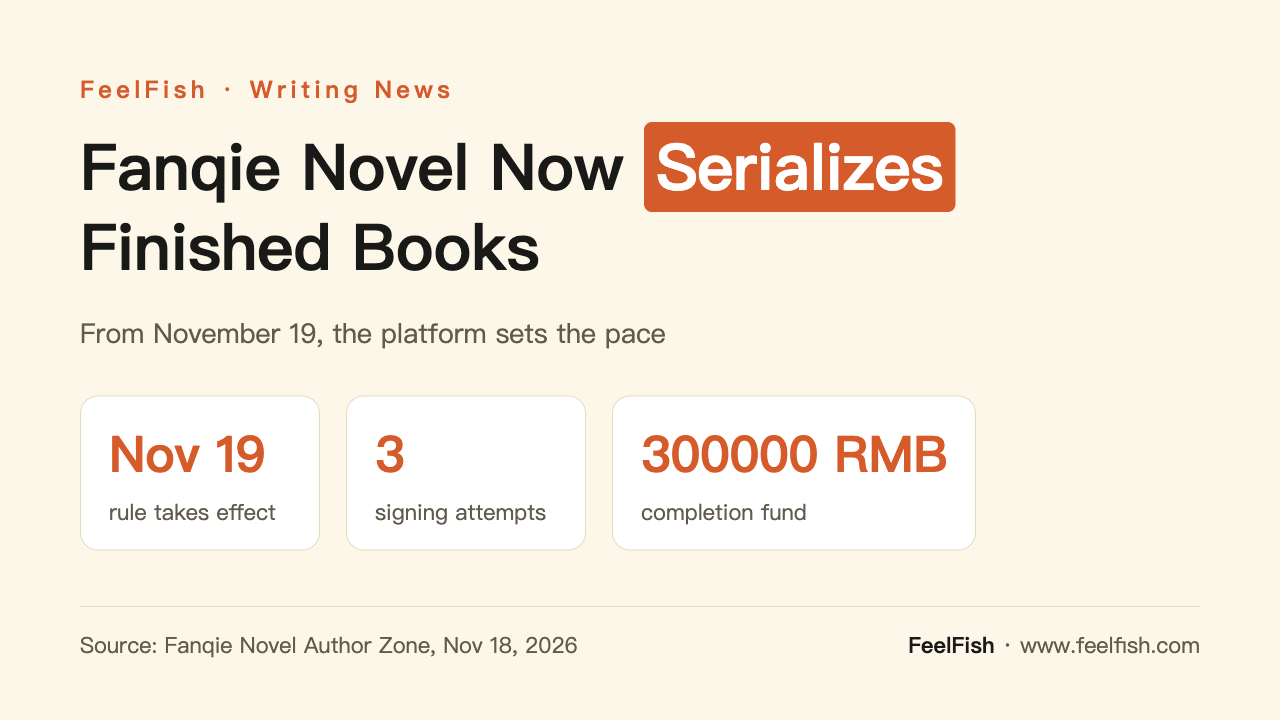
Fanqie Novel released a brief announcement of less than 300 words on November 18th, titled "Notice on Adjusting the Release Rhythm for Completed and Signed Works." However, it changed the most crucial aspect of completed and signed works: the timing and pace at which a finished book is presented to readers, shifting control from the author to the platform.
1. What Exactly Did the Announcement Change
Three changes will take effect from 0:00 on November 19, 2026:
- For works created in the completed mode, the platform will release chapters gradually after signing, until the entire book is fully updated;
- The status of the work in the author's backend will be displayed as "Ongoing", with an additional explanatory note;
- After a chapter passes review, its status will be "Pending Release", and it will only change to "Published" once readers can actually see it.
The announcement also clarified two common misunderstandings: the criteria for completed and signed works remain unchanged, as the mode is determined at the time of signing; and previously completed works are unaffected, with all published content remaining as is.
In other words: the book is still signed as a completed work, but it will be released at the pace of a serialized work. Previously, a completed work would be uploaded in its entirety after signing, but now the platform will release it chapter by chapter.
To check the actual status of your book, follow the path clearly stated in the announcement: PC end "Author Zone - Workspace - Work Management - Novel."
2. What Was Really Changed: The Word "Feedback"
Since the launch of the completed and signed model on September 7th, the logic has been "one-time delivery": the entire book is reviewed, the content is locked after signing, and each book has only three application opportunities. After October 12th, new works by Level 0 and Level 1 authors were limited to this route, while Level 2 and above could choose between serialization or completion.
The harshest part of these rules was not the word count threshold, but that you had no chance to revise. A serialized work could apply for signing with just 20,000 words, and if the data didn't look good, you could adjust the direction. For a completed work, you wrote hundreds of thousands of words in isolation, submitted it, and waited for judgment.
Now, the platform has broken down the release process into a serialized rhythm, which seems to give "feedback" back to the authors. But it's important to understand the boundaries:
The data is back, but the power to revise is not. As chapters are released one by one, you can see clicks, follows, average chapter views, and retention rates—metrics that were previously unavailable for completed works. However, the main text is already locked, so you can only watch the data without making any changes. The real purpose of these metrics is not to save the current book, but to help you identify where the issues lie when you write your next one.
Don't mistake "chapter-by-chapter release" for "release and revise." It's about fitting completed works into the serialized traffic pipeline, not turning completed and signed works into serialized and signed ones.
3. Why the Platform is Making These Changes
The announcement didn't provide a reason, but the direction is clear when you look at the platform's actions over the past three months: the platform wants manuscripts that are "completed and can be read through," not just "finished for the sake of being finished."
- In the October low-quality governance announcement, the platform reported that it had rejected 110,000 low-quality books and dealt with 15,000 low-quality and rule-violating books, specifically calling out AI-generated content, empty and watered-down writing, structural issues, and unfinished works.
- On November 9th, the platform launched the "United in Book Completion·Writing Together" incentive program, where successfully signed works could share up to 300,000 yuan, with individual book rewards potentially tripling.
- Now, they've added another rule: completed books should not be released all at once, but rather released in a controlled rhythm.
Releasing an entire book at once means readers will finish it in a few days and move on, resulting in no ongoing exposure, follow-up data, or adaptation evaluations. By releasing chapters gradually, the same book can repeatedly enter the recommendation pipeline for evaluation—this is the most direct benefit for the platform, and it also makes the performance of completed works comparable to that of serialized works.
For authors, the most practical implication is that the platform is now treating completed and signed works as a legitimate content supply line. It's no longer just a "narrow gate for newbies" but a channel that requires you to independently complete long-form works and withstand chapter-by-chapter scrutiny.
4. Three Things Authors Need to Change for Completed Works
First, don't plan your income based on "settlement upon release." Previously, the exposure was concentrated in the first few weeks after the entire book was released. Now, with chapters being released individually, the income curve will be stretched out and spread thinner. If you've already planned your cash flow based on a one-time payment, you'll need to recalculate.
Second, put all your effort into the pre-signing phase. With content locked and only three chances to make changes, the cost of revisions is prohibitively high. The only things that can save you are whether the first three chapters are engaging enough and whether the overall structure can support hundreds of thousands of words. Perfecting these at home is more useful than monitoring data after the book is live.
Third, don't use the backend status to gauge progress. The "serializing" status is just a label and doesn't mean you're actively updating. What you need to check is whether the chapters are in the "pending release" or "released" state. If you just published a chapter and see no views, first confirm if it's still in the pending release state—this can save you a lot of unnecessary panic.

5. A Checklist You Can Follow Directly
- Is my book in completed mode or serialized mode? This is determined at the time of signing the contract, so don't get confused when it's time to publish.
- Have I revised the title, synopsis, and the first three chapters to my satisfaction before signing the contract? There will be no more chances to change them after signing.
- Is my revenue plan based on a "one-time release" or a "chapter-by-chapter rollout"?
- In the backend, is each chapter marked as "pending release" or "released"? Which one am I looking at?
- After the data comes out, am I focusing on "how to save this book" or "what to improve in the next one"?
The requirements for signing a completed book have been changing over the past few months: the threshold was raised, and now even the release schedule has been tightened. The platform is filtering for authors who can truly finish their books and make them readable. The announcement didn't specify if there will be further changes, but before any new rules are implemented, solidifying the pre-contract phase is the only action that won't be in vain.
Information Sources
- Fanqie Novel · Author Zone, "Notice on Adjusting the Chapter Release Rhythm of Signed Completed Works," 2026-11-18: https://fanqienovel.com/writer/zone/article/7709025087524962329
- Fanqie Novel · Author Zone, "Fanqie Novel Low-Quality Content Governance Announcement (October)," 2026-11-18: https://fanqienovel.com/writer/zone/article/7709405659476803608
- Fanqie Novel · Author Zone, "Complete-Book Creation Incentive Campaign: 'Gather Strength to Write, Pen Together'," 2026-11-09: https://fanqienovel.com/writer/zone/article/7705005136027861017
- Jiemian News, "New Authors Must Finish a Whole Book to Get Signed: Fanqie Novel's New Rule Sparks Controversy," 2026-10-13: https://www.jiemian.com/article/15182681.html
- 36Kr, "Fanqie Novel Adjusts Signing Rules: The Honeymoon Period for New Authors Is Over," 2026-10-19: https://m.36kr.com/p/4032727949235079
About FeelFish
If you've read this far, you're likely either writing a novel or preparing to write one. You might want to try our tool, FeelFish:
- Consistent Long-Form Writing: Automatically incorporates the book's worldbuilding, character relationships, and previous plot points into the context, so you don't have to manually input background information every time.
- Multi-Agent Collaboration: Different agents handle planning, writing, and reviewing. When you get stuck, they provide several options to choose from, and someone will watch out for issues like inconsistent character development.
- Model Flexibility: Supports integration with popular models and allows you to use your own API Key.
Want to give it a try? Download FeelFish for free